An halo of asymmetrically expanding stars discovered in the super star cluster Westerlund 1, while its core appears to be contracting
Star clusters are a direct product of the star formation process: indeed, if the gravitational collapse of a cloud forms a sufficiently large number of stars, they remain bound by their mutual gravitational attraction for at least a few million years.
To date, two main mechanisms have been hypothesized for the formation of star clusters. Monolithic collapse predicts the rapid concentration of large amounts of gas in a limited region of the cloud, leading to the formation of a cluster that is very dense right from the start (in terms of the number of stars per unit volume). Hierarchical collapse, on the other hand, predicts the formation of various stellar subgroups in distinct centers, which subsequently merge to form a larger cluster. In recent years, the idea that the most massive clusters might form as a result of cloud-cloud collisions has also gained traction.
One way to distinguish between these proposed scenarios is to study the internal dynamics of the cluster. Indeed, the way its stars disperse outward or concentrate toward the center as a function of their mass makes it possible to trace back the potential formation mechanisms. However, this requires measuring the motion of every single star in the cluster—a feat made possible today thanks to missions like the European Space Agency’s (ESA) Gaia or observational campaigns such as the VISTA Variables in the Vía Láctea survey (VVV) and its extension (VVVx).
The research team led by astrophysicist C. Órdenes-Huanca (Pontificia Universidad Católica de Chile) analyzed VVVx data of the super star cluster Westerlund 1. In a previous study, the group identified 1286 intermediate-mass stars belonging to the cluster, whose kinematics they have now studied in detail.
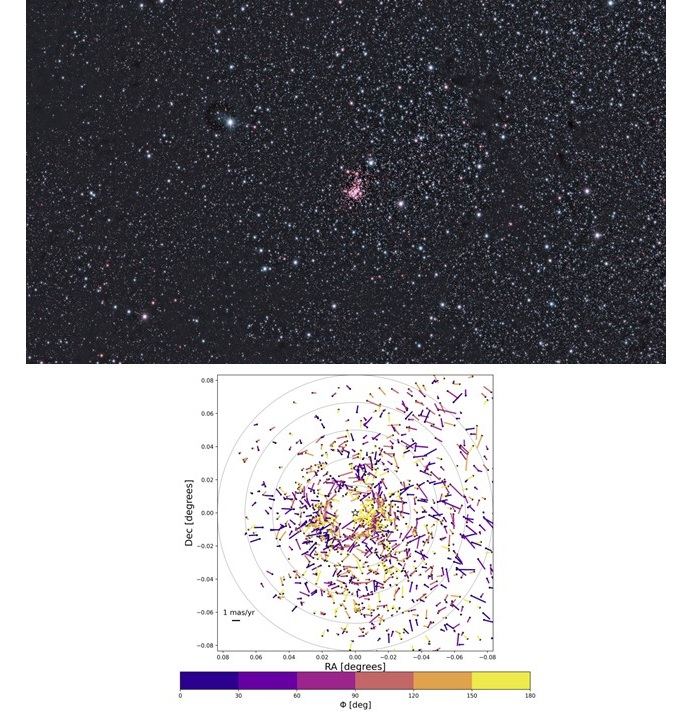
The study highlighted the presence of an outer halo of cluster stars moving away at various velocities. This expansion movement is not spherically uniform, but exhibits a preferential direction oriented at a position angle of 84° (measured from North to East). This asymmetry could reveal crucial details about the past history of Westerlund 1.
Furthermore, the authors observed that stars in the innermost region of the cluster show signs of possible contraction toward the center. Such a dynamical configuration is consistent with a formation scenario driven by the monolithic collapse of the parent cloud.
The study is described in the paper “EWOCS-VIII: Internal kinematics and expansion of Westerlund 1 from VVVX proper motions“, the eighth paper in the EWOCS (Extended Westerlund 1 and 2 Open Clusters Survey) series, published in the journal Astronomy & Astrophysics.
The cover image (click here to view it in full) shows an image of Westerlund 1 and the surrounding region taken with the VISTA Telescope (top panel), and a diagram illustrating the positions and sky-projected motions of the stars analyzed in this study (bottom panel). The color of the vectors indicates the direction of motion for each individual star.


Lascia un commento