Protoplanetary disks are disk-like structures observed around young stars, typically under 10 million years old. They are objects of great scientific interest for several reasons, primarily because they represent the structure in which planetary systems form and because they channel gas accretion onto the central star. For this reason, studying their physical properties and evolution is of paramount importance.
In recent years, various types of observations have shown that the evolution of protoplanetary disks—and consequently the way they form planets and transfer gas to the central star—can depend on their surrounding environment. In particular, ultraviolet (UV) radiation produced by nearby massive stars can significantly alter disk properties and evolution. This has fundamental implications: it could mean that in the presence of high-mass stars, low-mass stars accrete matter and form planets differently compared to isolated stars.
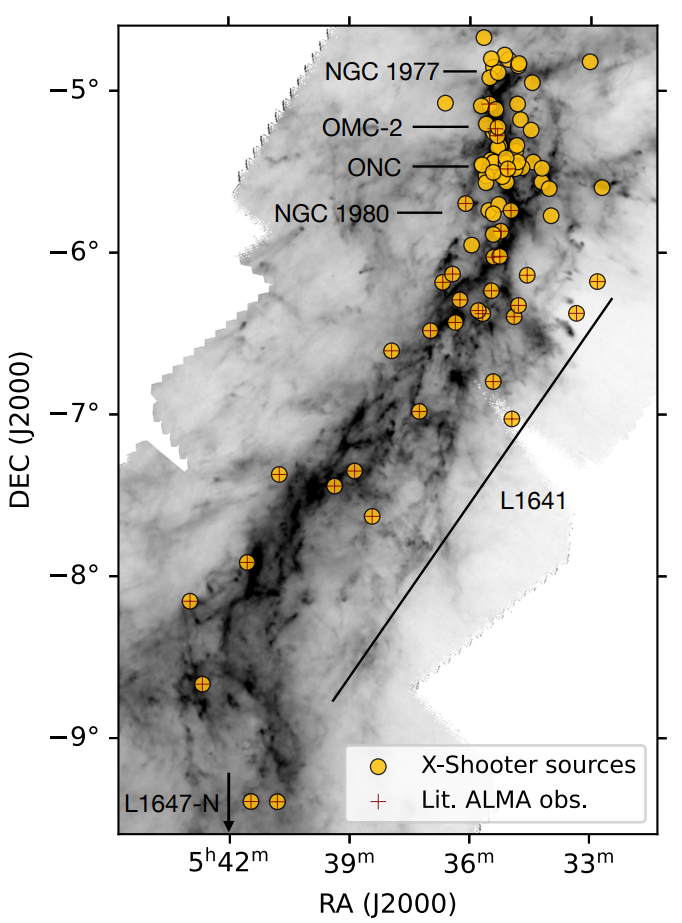
The research team led by astrophysicist L. Piscarreta from the European Southern Observatory analyzed spectroscopic observations obtained with the X-shooter instrument on the Very Large Telescope (VLT) of 91 young stars with protoplanetary disks in the Orion A star-forming region. These stars currently reside in varying UV environments: 31% and 38% are irradiated by weak and intermediate UV fluxes, respectively, while the remainder experience intense UV fluxes, with 5% located in regions of exceptionally high local UV flux.
Nevertheless, measurements of the accretion rate (i.e., the amount of gas accreting onto the star from the disk) and the radiated accretion luminosity show no dependence on local environmental conditions, and specifically on the incident UV flux on the disk. The researchers only observed a tendency for a fraction of the disks exposed to intense UV fluxes to exhibit faster dissipation timescales compared to those receiving less radiation, consistent with findings in other regions.
The research is presented in the paper “X-shooter survey Across Regions and Ages to probe Disk Evolution (ARADE): Accretion properties in Orion A and their relation with disk masses”, published in Astronomy & Astrophysics.
The image displays a far-infrared emission map of the Orion A cloud (obtained by the Herschel Gould Belt Survey), highlighting the stars analyzed in this study.


Lascia un commento