Within the structure and dynamics of the super star cluster Westerlund 1 may lie the imprint of a collision with the Milky Way’s galactic plane that occurred 2 million years ago.
Star clusters are extremely complex and fascinating dynamical systems. What makes them so complicated?
First and foremost, both the dynamical and physical evolution of their stars. Stars of different masses have different lifetimes: the most massive can end their evolution by exploding as supernovae while low-mass stars are still evolving toward the “maturity” of the Main Sequence. Furthermore, stars move rapidly within the cluster, exchanging energy, plunging toward its center, or “evaporating” as they move away.
To complicate matters further, there is the interaction between clusters and their surrounding environment: other star clusters, nebulae, and the entire Galaxy with its gravitational potential.
All of this leaves indelible imprints on the spatial and dynamical configuration we observe in star clusters today—imprints that in recent years we have been able to analyze with great precision thanks to the European Space Agency’s (ESA) Gaia satellite.
Gaia’s observational catalog contains accurate information on stellar positions and dynamics, complemented by spectroscopic data that allow us to determine the nature of the stars. Carefully analyzed, Gaia’s data provide a complete picture of the structure and dynamics of star clusters and their individual member stars.
The research team led by astrophysicist L. Prisinzano (INAF – Astronomical Observatory of Palermo) analyzed Gaia data for stars in the region of the super star cluster Westerlund 1, the subject of the EWOCS (Extended Westerlund 1 and 2 Open Clusters Survey) project led by M. G. Guarcello (INAF-OAPA). The researchers isolated a sample of 559 cluster stars with masses exceeding 7 solar masses.
These stars form two distinct kinematic groups: 421 stars remain gravitationally bound to the cluster core, while 103 are moving away from it (including 14 “walk-away stars” escaping at higher speeds than the rest). The two groups move at different velocities: their velocity dispersion is approximately 5 km/s for the first group and 10-14 km/s for the second group.
The cluster’s expansion is asymmetric, as demonstrated in other recently published studies. However, the analysis of Gaia data established that the outer region of Westerlund 1 is elongated perpendicular to the Milky Way’s plane, undergoing a distortion likely caused by the tidal forces of our Galaxy. Furthermore, its kinematic expansion timescale (2.08 million years) matches the exact moment Westerlund 1 crossed the galactic plane (2.1 million years ago). Among the various factors that could explain this dynamical evolution, this temporal alignment suggests a possible outcome of the interaction that occurred about 2 million years ago between Westerlund 1 and the matter (stars and nebulae) populating the Milky Way’s plane.
The study, the eleventh in the EWOCS series, is described in the article “EWOCS-XI: Anisotropic expansion and shear in the cluster Westerlund 1. A 2D kinematic analysis with Gaia DR3“, published in Astronomy & Astrophysics.
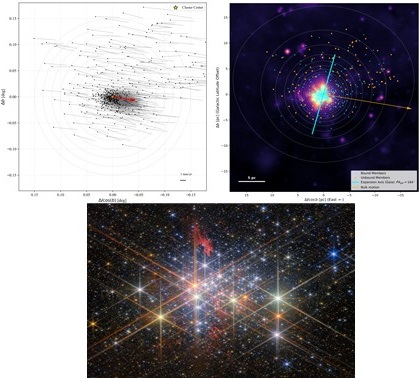
The cover image shows:
— In the top-left panel, the direction of proper motion (i.e., the motion projected onto our sky) of the Westerlund 1 stars analyzed in this study
— In the top-right panel, the spatial distribution of these stars—distinguishing between those bound and unbound to the cluster—alongside the direction of expansion and motion of Westerlund 1, overlaid on a mid-infrared image obtained by the WISE satellite. The lines illustrate the configuration of the Milky Way’s gravitational potential
— A JWST/NIRCam image of Westerlund 1


Rispondi