Three transiting planets orbiting a 400-million-year-old star
Understanding the process of planet formation and the early evolutionary stages of planetary systems represents one of the most significant challenges in contemporary astrophysics. Addressing this challenge requires complex photometric and spectroscopic observational campaigns targeting young stars, which are often embedded in crowded environments and characterized by nebular emission. Furthermore, young stars typically exhibit intense magnetic activity, which can produce signals that mimic those generated by transiting planets.
Demonstrating both the difficulty and the importance of this field of research are the numerous projects dedicated to characterizing young exoplanets. Notable among these are the contributions of NASA’s Kepler and TESS satellites for generating light curves—long photometric time series aimed at studying stellar variability and detecting transits—and the HARPS-N spectrograph, mounted on the Telescopio Nazionale Galileo (TNG), used to measure stellar radial velocities and identify variations induced by orbiting planets.
By leveraging Kepler and TESS observations (spanning 89 and 28 days, respectively), alongside 70 high-resolution spectroscopic observations obtained with HARPS-N, a research team led by early-career astrophysicist V. Fardella (University of Palermo and INAF – Astronomical Observatory of Palermo) determined the mass and nature of three transiting planets orbiting the star K2-233, a 400-million-year-old star with an effective temperature of approximately 4900 K. The three planets have orbital periods of roughly 2.4, 7, and 24 days.
The study revealed that the outermost planet, K2-233 d, has a mean density of about 0.46 times that of Earth and a radius of approximately 2.4 Earth radii. This size places it just above the so-called “radius valley,” the region separating sub-Neptunes from super-Earths. The planet still retains a primordial hydrogen-rich atmosphere; the evaporation of this gaseous envelope, driven by high-energy stellar radiation, could take more than 5 billion years if it possesses an Earth-like core, or less than a billion years if its internal structure is ice-rich.
In contrast, the inner planets, b and c, have already lost their primordial atmospheres (within 15–70 and 210–260 million years, respectively). The models developed by the team indicate that both planets possess an internal structure dominated by iron, with a significant silicate fraction.
The results were published in the journal Astronomy & Astrophysics in the paper titled “The GAPS Programme at TNG. LXXX. Characterisation of the 400 Myr old multi-planet system K2-233“, marking the 80th scientific paper produced by the international GAPS (Global Architecture of Planetary Systems) collaboration.
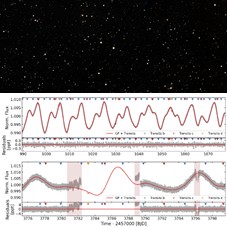
The cover image (click here to view in full) shows an image of the sky region around K2-233 at the top (extracted from the Digitized Sky Survey in the red band). The lower panel displays the light curves obtained by K2 (middle) and TESS (bottom): the gray dots represent the observed data points, while the red line indicates the theoretical model accounting for both stellar variability and planetary transits. The small brightness dips corresponding to the transits are marked by triangles of different colors for each of the three planets.


Rispondi