The study of galaxies in groups and clusters makes it possible to thoroughly examine the significance of environmental interactions in galactic evolution and star formation processes. Among the primary environmental mechanisms influencing galaxy properties are collisions, tidal interactions, and ram pressure. The first consist of collisions between distinct galaxies that typically merge into a single entity after multiple close encounters. Tidal interactions, on the other hand, result from the mutual gravitational attraction between galaxies passing each other at moderate relative velocities. Finally, ram pressure arises when a galaxy travels at high speed through the intergalactic medium (typically composed of high-temperature ionized gas).
Observations of galaxy groups and clusters therefore allow us to quantify the impact of these environmental factors in relation to the global properties of their host environments. In particular, in nearby systems, it is possible to spatially resolve the repercussions of such environmental effects on the individual internal structures of the galaxies themselves.
A research team led by astrophysicist L. Matijević (University of Zagreb and INAF – Astronomical Observatory of Padua) analyzed observations of the spiral galaxy NGC 2276—the second most massive member in the NGC 2300 group—obtained with the Galaxy Evolution Explorer (GALEX) and the Hubble Space Telescope (HST). Located approximately 95 million light-years away from us, NGC 2276 is well known for its peculiar asymmetric morphology, marked by a distinctly compressed edge, and for a prominent radio tail spanning roughly 330000 light-years. These characteristics may stem from tidal interactions with NGC 2300 (the group’s dominant galaxy) or from ram pressure exerted by the surrounding intergalactic medium. Previous studies estimated this medium to have a density of about , a temperature of roughly 10 million degrees, and a relative velocity with respect to NGC 2276 of nearly 970 km/s.
By combining observational data with galactic structure modeling, the researchers found that the stellar population in NGC 2276 older than 1.1 billion years is uniformly distributed throughout the disk, whereas the younger population exhibits a pronounced asymmetry associated with an intense star formation rate of about 12 solar masses per year. This contrast demonstrates that the recent morphological and stellar evolution of NGC 2276 is predominantly driven by ram pressure from the intergalactic medium rather than by tidal forces exerted by NGC 2300.
The study is detailed in the paper “The star formation history of NGC 2276: Comparison between spectral energy distribution modeling and hydrodynamical simulations”, published in the journal Astronomy & Astrophysics, in collaboration with astrophysicist K. Anastasopoulou from INAF – Astronomical Observatory of Palermo.
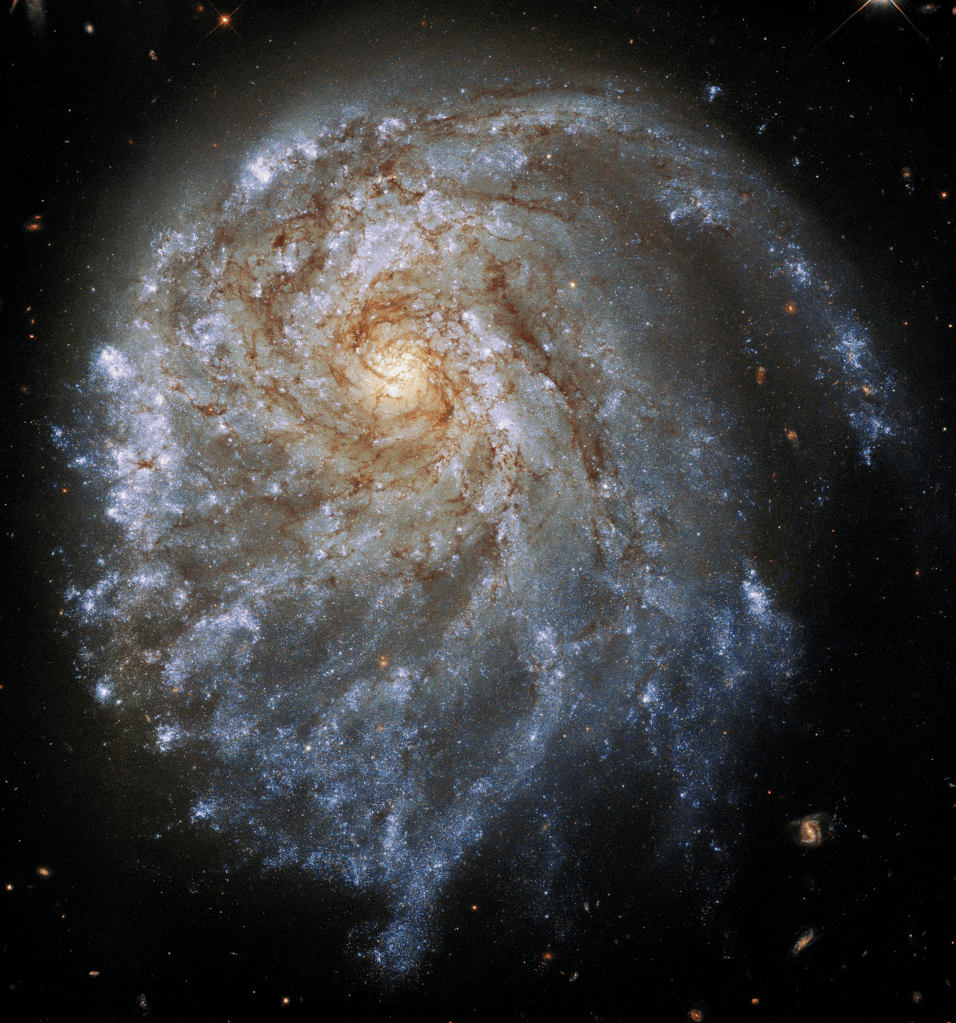
Image of NGC2276 obtained by the Hubble Space Telescope


Rispondi