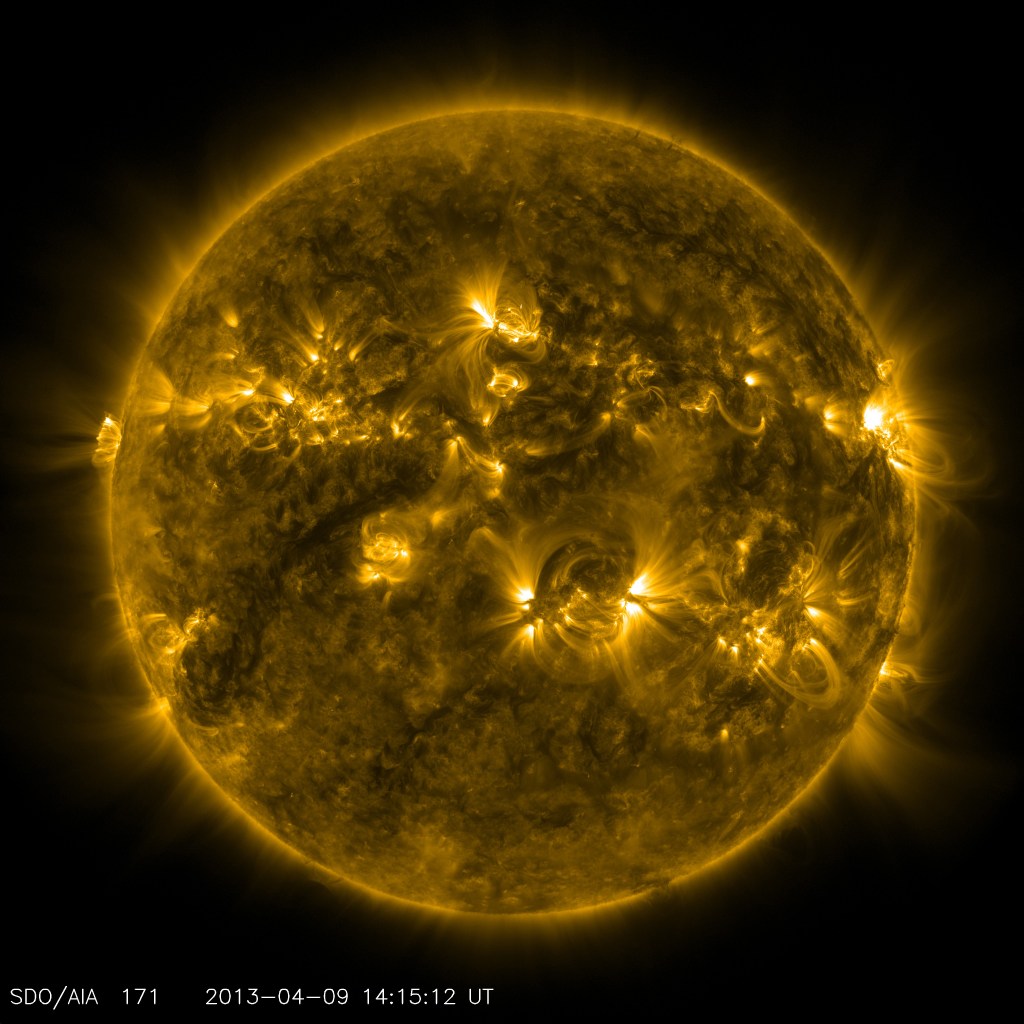
As obvious as it may seem, it is worth remembering that in the entire Universe there is only one star close enough for us to spatially resolve in detail the phenomena occurring in its photosphere, chromosphere, and corona: the Sun.
Our star therefore represents an unparalleled stellar physics laboratory, providing invaluable insights that enable us to interpret observations of all other stars.
This is especially true for the study of stellar magnetic activity—the ensemble of phenomena triggered and sustained by the interaction between stellar plasma and magnetic fields. It is this very interaction that gives rise to photospheric spots, active regions, and flares, and it is primarily responsible for heating the coronal plasma up to millions of degrees.
Indeed, only on the Sun can we observe these processes with high spatial resolution; for other stars, we almost exclusively capture disk-integrated signals.
This motivated the project ‘The Sun as an X-ray star’, which aims precisely to leverage the insights gained from solar coronal activity to better understand the high-energy (X-ray) radiation observed in other stars.
The methodological approach underlying the project was developed in the early 2000s by a research team from INAF – Palermo Astronomical Observatory in collaboration with the Department of Physics and Chemistry of the University of Palermo, through a series of papers demonstrating how the Sun can serve as a benchmark to interpret X-ray observations of other stars, linking the physical processes governing solar coronal activity to those shaping stellar atmospheres.
A research team led by astrophysicist W. M. Joseph (Eberhard Karls Universität Tübingen) verified the effectiveness of the method by treating the Sun as if it were a distant star, whose individual coronal structures cannot be spatially resolved. The corona reconstructed using this approach was then compared with the one actually observed on the Sun. The test was performed under two distinct levels of solar activity—during both a quiescent phase and a period of high activity—demonstrating that the method successfully reconstructs most of the coronal structure in both cases.
The method reconstructs the stellar coronae starting from the four coronal components:
- The quiescent component, characterized by plasma at 1–2 million degrees;
- Active regions, where magnetic activity heats the plasma to higher temperatures;
- Active region cores, where magnetic activity is even more concentrated;
- Flares, where impulsive releases of magnetic energy drive plasma temperatures above 10 million degrees.
The analysis reveals that the observed quiescent corona exhibits an active region coverage of 21%, whereas the active corona comprises a mixture of active regions (14%), dense cores (3%), and flares (0.07%). The framework proposed by this model can now be applied to the X-ray emissions of other stars to constrain the coronal filling factors of these four components.
These findings are detailed in the paper ‘The Sun as an X-ray star – V. A new method to retrieve coronal filling factors‘, published in Astronomy & Astrophysics, co-authored by astrophysicist S. Orlando from INAF – Palermo Astronomical Observatory.
📷 Cover image: An extreme-ultraviolet view of the solar corona, clearly highlighting several active regions.


Rispondi